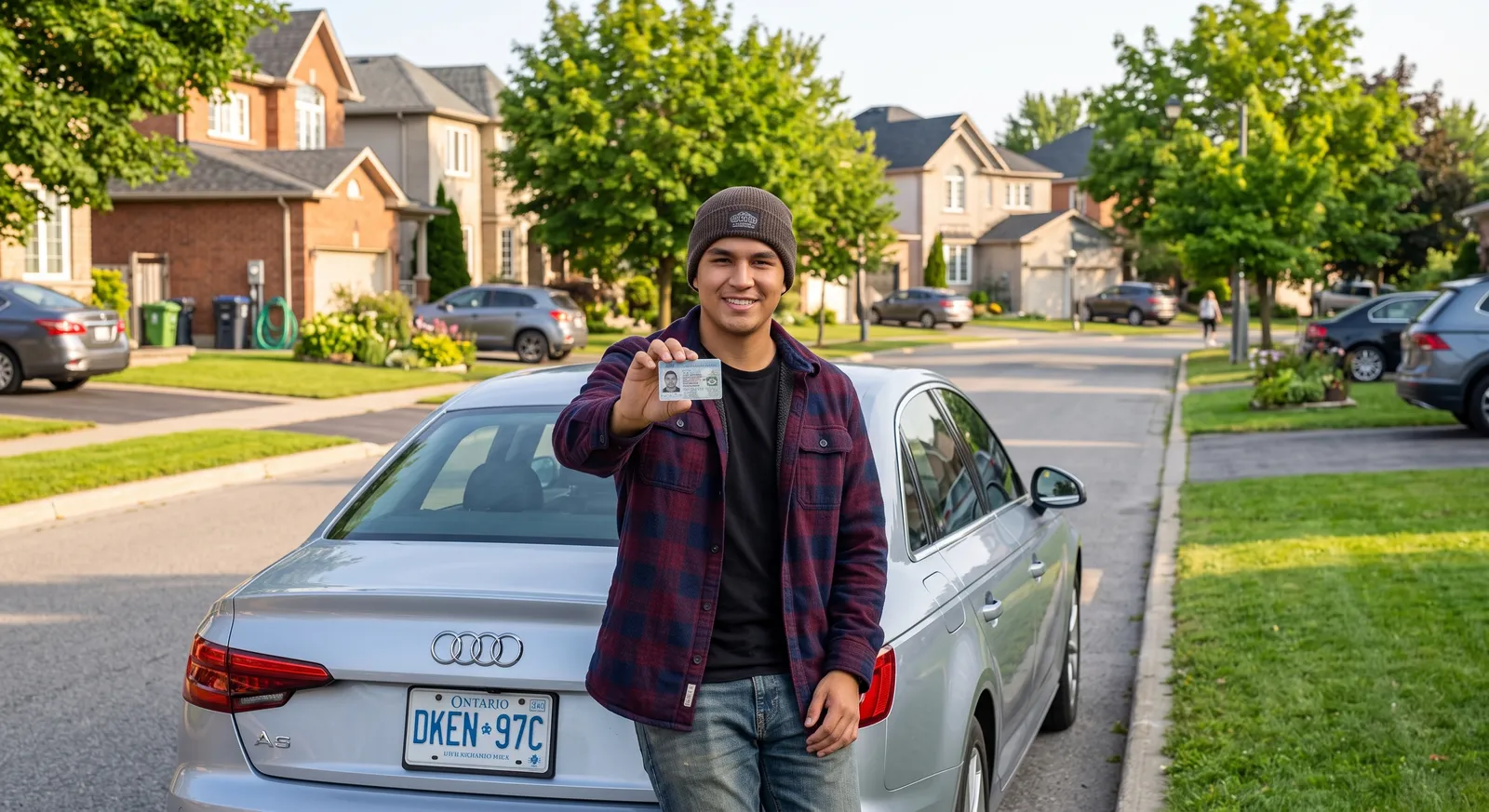
Ontario's New Foreign Licence Rules (July 1, 2026): What Actually Changed
Cet article est présentement disponible en anglais seulement.
Every figure and date below is checked against ontario.ca and the Ministry of Transportation. Where the official source is more specific than the headlines, this article follows the official source.
On July 1, 2026, Ontario changed how it counts foreign driving experience when a newcomer applies for a driver's licence. If you hold a licence from a country that has an exchange agreement with Ontario, almost nothing changed for you. If you hold a licence from a country that does not, the path to a full Class G licence got considerably longer. The distinction between those two groups is now the single most important thing to understand before you walk into a DriveTest Centre.
The Ministry of Transportation says the goal is program integrity: non-reciprocal licences and their supporting documents are often hard to authenticate because they carry limited security features, so the province tightened how much unverified experience it will accept. That is the honest framing. This is not a small administrative tweak, and for a lot of new residents it adds a year or more before they can drive on a full licence.
What actually changed
The change applies to drivers from non-reciprocal jurisdictions, meaning countries that do not have a licence-exchange agreement with Ontario. Before July 1, the amount of foreign experience these drivers could claim was handled differently. As of July 1, 2026, the rule is fixed and capped.
Here is what the province now requires of a driver from a non-reciprocal jurisdiction:
- You can get credit for a maximum of 12 months (one year) of verified foreign driving experience. Even if you have driven for a decade, the most Ontario will count is one year.
- You must pass the vision test, the knowledge (written) test, and the G2 road test to enter Level Two of graduated licensing.
- You must then wait at least 12 months after passing the G2 road test before you are eligible to attempt the G road test for a full licence. Your foreign experience cannot shorten that 12-month wait.
- To claim more experience than what is printed on your foreign licence (up to the 12-month cap), you must provide an official letter of authentication from the government or agency that issued the licence, written in English or French.
In plain terms: a driver from a non-reciprocal country now goes through essentially the same road-test sequence as a brand-new Ontario driver, minus up to a year of the graduated-licensing waiting time. Two tests, a mandatory 12-month gap between them, and paperwork to prove your experience.
If you are preparing for the knowledge test that now sits at the front of this process, it is worth practising with real Ontario-style questions before you book. [[CTA: ontario-driving-test | Try the free Ontario practice test]]
Who is affected
You are affected by the new rules if all of the following are true:
- Your driver's licence was issued by a country without an exchange agreement with Ontario.
- You are establishing residency in Ontario and need an Ontario licence.
That covers a large share of newcomers. Ontario's exchange-agreement list is specific, and any country not on it is treated as non-reciprocal. If your licence is from, for example, India, China, Nigeria, the Philippines, Brazil, or most of the Middle East, you are in this group and the 12-month cap plus the two-test sequence applies to you.
A practical wrinkle: if your foreign licence was issued fewer than 12 months before you apply, but you have more than that in actual driving history in that jurisdiction, the printed issue date alone will not get you full credit. That is exactly where the letter of authentication matters. Without it, Ontario credits only what your licence document shows.
Who is NOT affected
The new rules do not change the deal for drivers from reciprocal jurisdictions. Ontario has licence-exchange agreements with every Canadian province and territory, all U.S. states, the Canadian Armed Forces, and a defined list of countries including Australia, Austria, Belgium, Croatia, Denmark, France, Germany, Great Britain, Hungary, the Isle of Man, Japan, Kosovo, New Zealand, Northern Ireland, the Republic of Ireland, South Korea, Switzerland, Taiwan, and Ukraine.
If you hold a valid Class G-equivalent licence from one of these places and you have at least two years of driving experience, you exchange straight into a full Class G licence. No knowledge test, no road test. You still take a vision test, but that is it. That is unchanged by the July 1 rules.
If you are from a reciprocal jurisdiction with less than two years of experience, you also avoid the new non-reciprocal sequence: you get credit for your experience and enter Level Two (G2), then take the Level Two road test once you reach two years of total driving experience. This is the long-standing exchange framework, and it is a genuinely faster route than the one non-reciprocal drivers now face. We cover it in detail in how to exchange a foreign licence in Canada and skip the written test.
Before and after: non-reciprocal jurisdictions
The table below compares the two groups under the rules now in force. The "before" column reflects the position of a non-reciprocal driver prior to July 1, 2026.
| Situation | Reciprocal jurisdiction (unchanged) | Non-reciprocal, before July 1 2026 | Non-reciprocal, from July 1 2026 |
|---|---|---|---|
| Max foreign experience credited | Full credit toward the 2-year full-licence threshold | Handled case by case | 12 months maximum |
| Knowledge (written) test | Not required (2+ yrs experience) | Required | Required |
| G2 road test | Not required (2+ yrs experience) | Required | Required |
| G road test | Not required (2+ yrs experience) | Required | Required |
| Wait between G2 and G | Not applicable | Could be reduced by experience | At least 12 months, cannot be reduced |
| Authentication letter | Needed to claim experience beyond the licence | Varied | Required to claim experience beyond the licence |
| Result | Full Class G on exchange (vision test only) | Faster path in some cases | Full Class G roughly a year after passing the G2 test |
The single biggest practical effect is the bottom row. A non-reciprocal driver who passes everything on day one still cannot hold a full G licence until at least 12 months after the G2 road test. Experience no longer buys down that wait.
What to do now
If you are moving to Ontario or have recently arrived, here is the honest checklist.
- Confirm which group you are in. Check whether your licence-issuing country is on Ontario's exchange-agreement list. This determines everything else. When in doubt, treat your licence as non-reciprocal and plan accordingly.
- Apply within 60 days. A new resident can drive on a valid out-of-province or foreign licence for 60 days after establishing residency. After that, you must have switched to an Ontario licence. Do not let the clock run out while you gather documents.
- Gather your authentication letter early. If you want credit for experience beyond what your licence shows (up to 12 months), you need an official letter from the issuing government, consulate, embassy, or high commission, in English or French. These take time to obtain from abroad. Start now.
- Book and pass the knowledge and vision tests. For non-reciprocal drivers these come first, before the G2 road test. This is the stage most within your control, and the one people most often underestimate.
- Plan for the 12-month gap. If you are non-reciprocal, build your life around a full year of G2-level driving (which carries its own conditions, including a zero blood-alcohol requirement) before you are eligible for the G road test.
The rules are stricter, but the knowledge test itself is not hard if you actually study for it, and a meaningful share of applicants walk in unprepared and fail. That is avoidable.
Questions fréquentes
What changed for foreign drivers in Ontario on July 1, 2026?
For drivers from countries without a licence-exchange agreement with Ontario, the province now credits a maximum of 12 months of foreign driving experience. Those drivers must pass the vision test, knowledge test, and G2 road test, then wait at least 12 months before taking the G road test. The 12-month wait cannot be shortened by prior experience.
Does the new rule affect me if my licence is from the U.S., U.K., or another exchange country?
No. If your licence is from a reciprocal jurisdiction (all Canadian provinces and territories, all U.S. states, and a specific list of countries such as Great Britain, Australia, Germany, Japan, and South Korea) and you have at least two years of experience, you still exchange directly into a full Class G licence with only a vision test. No knowledge or road test.
How much foreign driving experience can I get credit for now?
For non-reciprocal jurisdictions, the maximum is 12 months, regardless of how many years you have actually driven. To claim experience beyond what your physical licence shows, up to that 12-month cap, you must provide an official letter of authentication from the issuing authority, written in English or French.
How long do I have to switch to an Ontario licence after moving here?
Sixty days. A new resident can use a valid out-of-province or foreign licence for 60 days after establishing residency. After that, an Ontario licence is mandatory.
Do I still have to take a written test if I have years of driving experience abroad?
If your licence is from a non-reciprocal jurisdiction, yes. The knowledge (written) test is required regardless of how long you have driven. Only drivers exchanging from reciprocal jurisdictions with two or more years of experience skip the written test.
Why did Ontario tighten these rules?
The Ministry of Transportation says non-reciprocal licences and their supporting documents are often difficult to authenticate because they carry limited security features. The stated aims are to strengthen licensing requirements, reduce fraud, and align Ontario with practices used in other jurisdictions.
Prêt à commencer à étudier ?
Entraînez-vous avec de vraies questions d'examen canadiennes et des explications instantanées, et suivez votre préparation avant de réserver.
Start the free Ontario practice testTests pratiques gratuits pour chaque province et territoire