School bus rules across Canada: the question almost everyone gets wrong
Cet article est présentement disponible en anglais seulement.
Rules and penalties below are drawn from official provincial sources (ontario.ca / MTO, SAAQ, ICBC and the Government of B.C., Alberta Transportation, and MPI / Government of Manitoba). Fines change often. Where we could not confirm a figure directly from a government page, we say so.
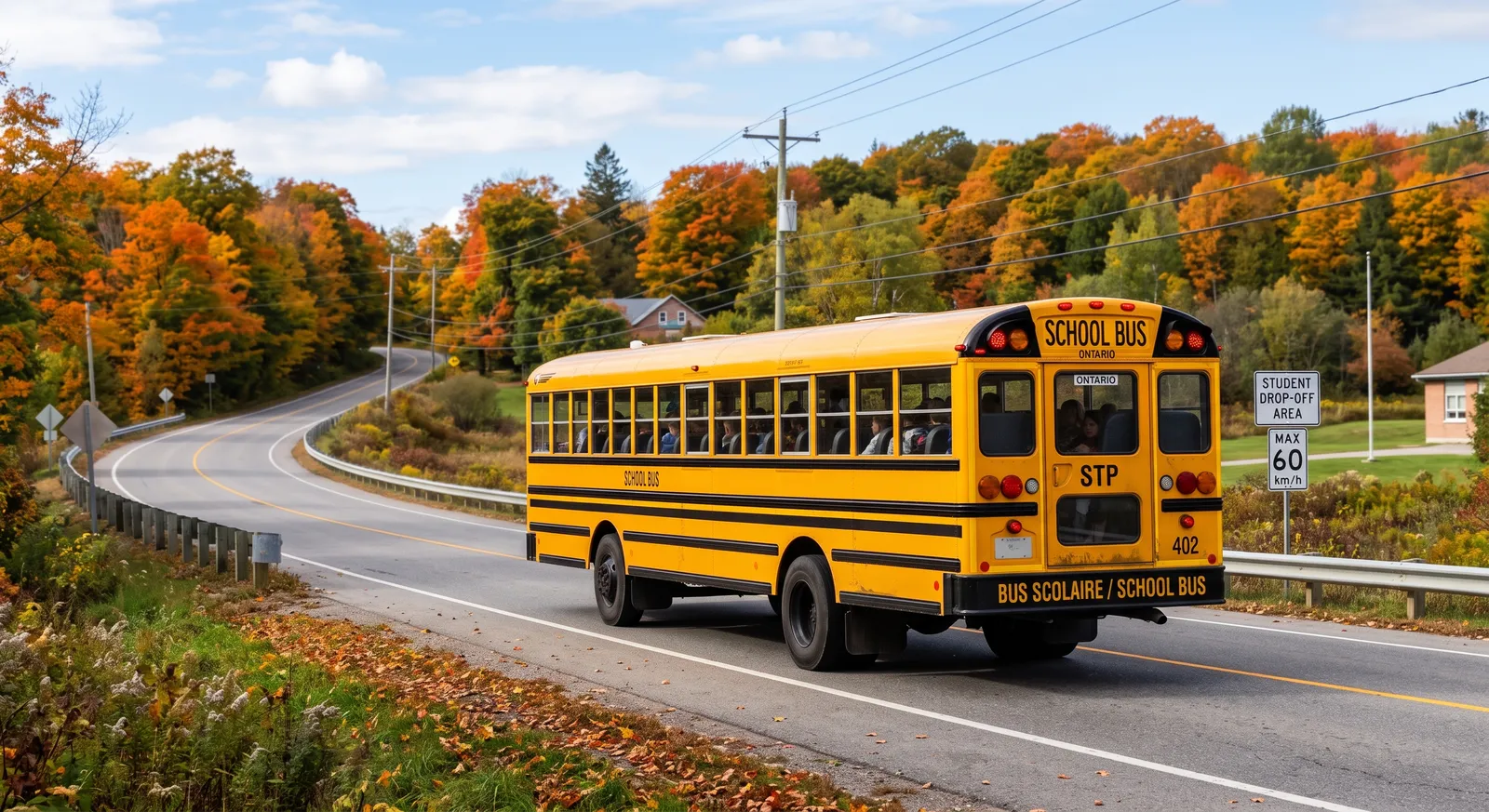
There is one road rule that catches out more new drivers, and more experienced ones, than almost anything else on a Canadian knowledge test. It sounds simple. A school bus stops ahead of you, its upper red lights flashing and its stop arm swung out. You stop. Everyone knows that part.
The part people get wrong is the bus coming toward you, on the other side of the road. Do you stop too?
On most roads, yes. And that is the answer a large share of test-takers, and drivers, get backwards.
The rule in one sentence
On an undivided road, you must stop for a school bus with its red lights flashing no matter which direction you are travelling, whether you are behind it or approaching it head-on. On a divided highway (one split by a raised, lowered, or physical median), traffic on the opposite side of the median does not have to stop.
That is the whole trap. People assume "the other side of the road" always means "not my problem." It usually is your problem. The exception is narrower than most people think: it applies only when there is an actual physical median between you and the bus. A painted centre line, even a double solid yellow one, is not a median. If the only thing separating you from the bus is paint, you stop.
This distinction is why the topic shows up so often on knowledge tests. It is a clean way to separate drivers who memorized "stop for the bus" from drivers who understand *why*. Children cross in front of a stopped bus. A driver coming the other way on a two-lane road is exactly the car that would hit them.
What "divided" actually means
Read a test question carefully and the answer is usually hiding in one or two words.
- If the question says "divided highway" or mentions a "median" or "physical barrier," the opposite-direction traffic is exempt.
- If it says "two-lane road," "road with a centre line," "undivided," or gives no divider at all, you stop from both directions.
- The number of lanes does not decide it. A wide multi-lane road with no median still counts as undivided, and you stop both ways.
This is also worth getting right off the test, because the penalties for missing it are steep, and in several provinces they climb sharply on a second offence.
Province-by-province comparison
The core rule (stop both ways unless a median divides you) is consistent across the country. What differs is the stopping distance, the fine, and the demerit or penalty points. Here is what the official sources say as of July 8, 2026.
| Province | Undivided road | Divided highway (physical median) | Minimum stop distance | Fine (first offence) | Demerit / penalty points |
|---|---|---|---|---|---|
| Ontario | Stop from both directions | Opposite side need not stop | At least 20 m behind the bus | $400 to $2,000 (rises to $1,000 to $4,000 on a 2nd offence within 5 years) | 6 |
| Quebec | Stop from both directions | Opposite side of median exempt | More than 5 m | Roughly $200 to $300 plus fees (see flag) | 9 |
| British Columbia | Stop from both directions | Opposite side exempt | Not fixed in metres | $368 | 3 |
| Alberta | Stop from both directions | Opposite side of median exempt | No set metre distance in the bulletin | $402 | 6 |
| Manitoba | Stop from both directions | Opposite side of divided road exempt | At least 5 m, front and rear | $530 | 2 |
A few things stand out.
Quebec hands out the most points. Nine demerit points for one offence is among the harshest point penalties in the country, even though the base fine is comparatively low. For a new driver in Quebec, whose licence tolerates only four demerit points, a single violation is enough to lose it.
Ontario has the widest fine range and the sharpest escalation. A first offence starts at $400 but can reach $2,000, and a second within five years can hit $4,000, six more demerit points, and up to six months in jail. In Ontario the registered owner of the vehicle can also be fined even if the driver is not the one charged.
Manitoba's point penalty looks small but isn't the whole story. Two demerit points understates it, because Manitoba runs a Driver Safety Rating system where a school bus violation moves you down the scale and raises your insurance. The province has also debated raising penalties further, so treat $530 as the current figure, not a permanent one.
The stopping distance is not uniform. Ontario wants you at least 20 metres back. Quebec and Manitoba use 5 metres. British Columbia and Alberta do not publish a single fixed number in their driver materials, so the practical rule there is to stop far enough back that children have clear, safe room to cross.
Where the sources disagree
For Alberta, secondary sources (news articles, insurance and driving-school pages) frequently quote a fine of $567. Alberta Transportation's own school bus safety bulletin lists $402. The gap is almost certainly the provincial victim-fine surcharge added on top of the base fine at the courthouse. We use the official base figure, $402, and flag that what you actually pay may be higher once surcharges are added.
For British Columbia, the $368 fine and 3 penalty points are confirmed by the Government of B.C.'s own announcement when the penalty was more than doubled, and by ICBC. Some older articles still cite the pre-increase amount; ignore those.
For Quebec, the 9 demerit points figure is consistently attributed to the SAAQ, and the rule (stop more than 5 metres away, from both directions, median exempt) is stated in SAAQ material. We were not able to load the SAAQ penalty pages directly to confirm the exact dollar fine, because the SAAQ site is behind bot protection. Treat the Quebec fine as approximate and verify it on the SAAQ site before relying on the number.
Why this one question is worth studying
If you want a single indicator of whether someone actually prepared for the knowledge test or just skimmed, this is it. The school bus questions are not hard. They reward reading carefully (divided versus undivided) and knowing that a painted line is not a barrier. That is exactly the kind of detail our breakdown of the hardest G1 questions keeps coming back to: the test is easy if you study, and a lot of people don't, then blame the test.
Learn the rule once and it holds nationwide, with only the distance and the penalty changing between provinces.
Questions fréquentes
Do you have to stop for a school bus coming from the other side of the road?
On an undivided road, yes, in every province covered here. You stop whether you are behind the bus or approaching it from the opposite direction. The only exception is a divided highway with a physical median between you and the bus. A painted centre line does not count.
What counts as a divided highway for school bus rules?
A road split by a raised, lowered, or otherwise physical median or barrier. On such a road, traffic on the far side of the median is not required to stop. A double solid yellow line, or any painted marking, is not a median, so you must still stop.
How far back do you have to stop for a school bus?
It depends on the province. Ontario requires at least 20 metres behind the bus. Quebec and Manitoba require at least 5 metres. British Columbia and Alberta do not publish a fixed distance, so stop far enough back to leave children a clear, safe path to cross.
What is the fine for passing a stopped school bus?
As of July 2026: Ontario $400 to $2,000 for a first offence (higher on a second); Quebec roughly $200 to $300 plus fees; British Columbia $368; Alberta $402 (before surcharges); Manitoba $530. Fines change often, so confirm the current amount on the official provincial page before you rely on it.
How many demerit points do you get for not stopping for a school bus?
Quebec 9, Ontario 6, Alberta 6, British Columbia 3 (penalty points), and Manitoba 2 (plus a Driver Safety Rating drop). Quebec's nine points is enough on its own to cost a new Quebec driver their licence.
When can you legally pass a school bus?
Once the red lights have stopped flashing and the stop arm has folded back in, and only where passing is otherwise permitted. While the red lights flash and the stop arm is out, you wait, regardless of how long it takes.
Prêt à commencer à étudier ?
Entraînez-vous avec de vraies questions d'examen canadiennes et des explications instantanées, et suivez votre préparation avant de réserver.
Start a free Ontario practice testTests pratiques gratuits pour chaque province et territoire