Ontario G1 Knowledge Test Practice 2026
40 questions in two sections of 20, road signs and rules of the road. You need 16 of 20 (80%) in EACH section; failing either section fails the test. Use these free practice tests to study the rules of the road, traffic signs, and Ontario-specific laws before your appointment.
Readiness scoreTargets weak spots
Use Pro, reach an 80% IQ Readiness Score and still fail? We refund your plan. Conditions apply.
HOW WE HELP YOU PREPARE
306+ practice questions to help you master the Ontario knowledge test, 4 practice runs that cover every topic, plus a full mock exam.
ONTARIO REQUIREMENT TO PASS
40 questions in two sections of 20, road signs and rules of the road. You need 16 of 20 (80%) in EACH section; failing either section fails the test. No published time limit.
Verified November 2026 by our editorial team from Official MTO Driver's Handbook. Rules change, so always confirm with the current official materials from Ministry of Transportation Ontario (MTO) before your test.
Use Pro, reach an 80% IQ Readiness Score and still fail? We refund your plan. Conditions apply.
Study by Category
Master each topic before your Ontario written test. 4 categories are free to start.
Study your weak spots first
Practice Runs
Four runs that mix every topic on the test, like a short version of the real exam. Sets A to D never repeat a question. Two are free; two more with Pro.
- G1 Practice Test 3: All Topics, Set CProIncludes cargo, licence classes and skids, plus every other topic on the test. No repeats across Sets A to D.25 questions · ~15 minGet Pro
- G1 Practice Test 4: All Topics, Set DProIncludes farm equipment, hazard signs and tailgating, plus every other topic on the test. No repeats across Sets A to D.25 questions · ~15 minGet Pro
Pro Study Tools
The full learning system, on the site and in the app.
- Ontario G1 Exam Simulator 2026ProFull mock exam in the real test's format. Where the licensing authority publishes the length, pass mark and time limit, it uses them.Get Pro
- Quick G1 Practice QuizProQuestions drawn from your weak areas, randomised every time you open it. No two quizzes are the same.Get Pro
- Build a Custom TestProPick topics, difficulty and which questions to include.Get Pro
- IQ Readiness Score™ AnalysisProDetailed breakdown of your strengths, weak spots, and how ready you are.Get Pro
Related guide: how long G1 to full G really takes.
Related guide: what Ontario drivers 80 and older must do to renew.
Everything to know about the Ontario G1 Knowledge Test
Ontario's G1 knowledge test is the first step in the province's three-stage Graduated Licensing System. It's a 40-question multiple-choice test in two sections, 20 questions on road signs and 20 on rules of the road, and you need at least 16 of 20 (80%) in EACH section. Failing either section fails the test. The test is administered at DriveTest centres on behalf of the Ministry of Transportation Ontario (MTO).
You can write the test starting at age 16. The computerized test is offered in 32 languages, including English and French, and you can ask for a verbal test or bring an approved interpreter. No time limit is published for the test.
Once you pass, you're issued a G1 licence. As a G1 driver you must have an accompanying driver with a valid Class G (or higher) licence, at least four years of driving experience and a blood-alcohol level under .05% in the front seat at all times, your own blood-alcohol level must be zero, you may not drive between midnight and 5 a.m., and you cannot drive on 400-series highways with a posted limit over 80 km/h or certain other high-speed roads. You can take the G1 exit road test (for your G2) after holding your G1 for 12 months, or 8 months if you pass an approved Beginner Driver Education course.
After passing the G1 exit road test you hold a G2 licence and can drive on any road in Ontario, but restrictions remain: a 0.00 blood-alcohol level, and if you're 19 or under, between midnight and 5 a.m. you may carry only one passenger aged 19 or under for your first six months on the G2, then up to three. The full Class G licence comes after passing the G road test, which can be taken 12 months after getting your G2.
Ontario's test focuses on rules drivers actually use: right-of-way, school-bus laws (red flashing lights mean stop in both directions on undivided roads), winter-driving readiness, and the move-over rule for emergency vehicles. The MTO updates the handbook periodically, so always study the most recent edition.
Brushing up on Canadian road signs? Our sign-specific practice covers every regulatory, warning, and information sign you'll see on the test.
Ontario: rules to know
Ontario uses an advanced green (a flashing green light or a left-pointing green arrow with a green light) at some signalled intersections. Right-on-red after a complete stop is allowed unless a posted sign prohibits it. The Move Over law requires drivers to slow down when approaching a stopped emergency vehicle with its lights flashing, or a stopped tow truck with flashing amber lights, and to move into a lane away from it where there are two or more lanes and it is safe to do so.
Key points for Ontario
A ministry-approved beginner driver education course is at least 40 hours: 20 in-class, 10 in-vehicle and 10 flexible. Completing it is noted on the licence history and cuts four months from Level One, so Level One lasts eight months instead of 12. If a G1 or G2 is about to expire before the process is finished, a driver can regain the same class by passing a test and paying the five-year licensing fee. If it expires first, they must reapply for Level One.
Road tests must be prepaid. Cancelling or rescheduling with less than 48 hours notice, or not attending, forfeits the prepaid fee. If the test is declared out of order because the vehicle is not up to standard or the examiner cannot complete it, you lose 50% of the fee: the other 50% stays as a credit, and you pay the lost 50% to rebook. Electronic driving aids such as automatic parallel-parking, lane monitoring, cruise control and back cameras may not be used, and no pets or passengers other than the examiner may be in the vehicle.
The G2 exit road test for a full G needs a signed Declaration of Highway Driving Experience, covering freeway or 80 km/h plus highway driving. Without enough experience, the examiner can declare the test out of order. The G road test currently omits parallel parking, roadside stops, 3-point turns and residential driving, which the G2 test covers. The handbook calls this exit test the Level Two road test, while ontario.ca calls it the G road test. Passing gives a full Class G licence, and drivers aged 80 or older must renew every two years.
Level One and Level Two drivers get a warning letter at two demerit points, a second at six, and a 60-day suspension at nine or more points in two years; points drop to four afterwards. Novice drivers who break a novice condition or commit an offence worth four or more points face the Novice Driver Escalating Sanction suspension, and the points are recorded as zero. For G1, G2, M1 or M2 holders, a distracted driving conviction brings no demerit points but a 30-day suspension for a first conviction, 90 days for a second, and cancellation from graduated licensing for a third.
Try it yourself
Get a taste of the study experience. Answer a real question or preview the timed exam simulator.
Sample flash card
What happens if a fully licensed Ontario driver is found with a blood alcohol concentration (BAC) in the 'warn range' of 0.05% to 0.08%?
Try all free practice runs
Start practicingWhen approaching a school zone during posted hours, the maximum speed limit in Ontario is:
Exam Simulator
Full 40-question mock exam. Same length as the real Ontario test. Pass mark: 80% in each section (16 of 20). No published time limit.
Know how ready
you are for the Ontario test
The IQ Readiness Score™ measures six dimensions of test readiness and shows how ready you are for the Ontario exam, from 0 to 100%.
View full readiness reportFrequently Asked Questions
The G1 test has 40 questions in two sections of 20: road signs and rules of the road. You need 16 of 20 (80%) in each section, and failing either section fails the test, so a strong score in one section cannot cover a weak one.
There is no cap on attempts, and each extra attempt costs C$16. DriveTest publishes no waiting period after an ordinary fail. Your results are valid for one year, and within that year you re-sit only the sections you failed.
No. Ontario lists no standalone first-attempt fee. The G1 licence package costs C$159.75 and includes the knowledge test, a G2 road test and a five-year licence. Only extra knowledge test attempts are charged separately, at C$16 each.
You must show proof of your legal name and date of birth, including the day, month and year. Documents must be original and valid; photocopies and expired documents are not accepted. Bring them to a DriveTest Centre or a Travel Point, a temporary DriveTest centre where there is no regional centre.
Yes. The computerized G1 test is offered in 32 languages, including English and French, with an audio version. You can also take it verbally with a DriveTest employee, or bring an approved interpreter at your own cost. The paper version is offered in 20 languages.
You must be at least 16 to apply for a G1. Graduated licensing has three stages: G1, then G2, then the full G licence. Moving up from G1 to G2 and from G2 to G each requires a road test, so Ontario has two road tests in total.
Twelve months by default, counted from the day you get your G1. An approved Beginner Driver Education course cuts that to 8 months. The G2 stage then lasts 12 months, so the fastest path to a full G is 20 months. Ontario sets no minimum number of supervised practice hours.
G1 drivers must have zero blood alcohol and may not drive between midnight and 5 a.m. They may not use 400-series highways with a posted limit over 80 km/h, or certain high-speed roads such as the QEW, unless the accompanying driver is an instructor. That front-seat driver needs at least 4 years of experience and a blood alcohol level under 0.05.
Between midnight and 5 a.m., a G2 driver aged 19 or under may carry only one passenger aged 19 or under in the first six months. After six months, and until a full G or age 20, up to three. Novice drivers must also have a seatbelt for every passenger; failing that can mean losing the licence for at least 30 days.
Warn-range drivers (.05 to .08) get an immediate roadside suspension: three days for a first occurrence, seven days and a remedial alcohol-education program for a second. A blood alcohol over .08, or refusing a sample, brings a 90-day administrative licence suspension and a seven-day vehicle impoundment. Drivers aged 21 and under must have zero blood alcohol, and a roadside result brings a 24-hour suspension.
New residents may use a valid out-of-province or foreign licence for 60 days; after that they need an Ontario licence. From 1 July 2026, applicants from a jurisdiction without an exchange agreement can claim a maximum of 12 months of driving experience from an original, valid foreign licence, and only experience in the past three years counts. A letter of authentication for foreign driving experience must be in English or French.
The distracted driving law applies even stopped in traffic or at a red light. You may use a hands-free device with an earpiece, lapel button or Bluetooth, and a mounted device is allowed if it is secure. For drivers with an A to G or M licence, a first conviction is $615 out of court, three demerit points and a 3-day suspension.
It depends on where your licence was issued. Ontario exchanges licences from some countries with no road test, credits your driving experience in others, and requires the full test for the rest.
See Ontario's licence exchange rulesMost missed free practice questions in Ontario
These free questions have the lowest first-answer scores among learners who tried them. Shares are rounded to the nearest 5 percent.
About 35% answer this correctly
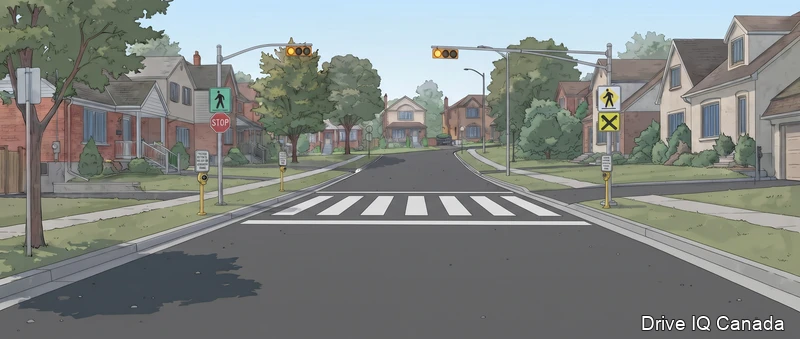
How many demerit points are assigned for failing to stop at a pedestrian crossover?
Answer: 4 points
Failing to stop at a pedestrian crossover carries 4 demerit points.
About 40% answer this correctly
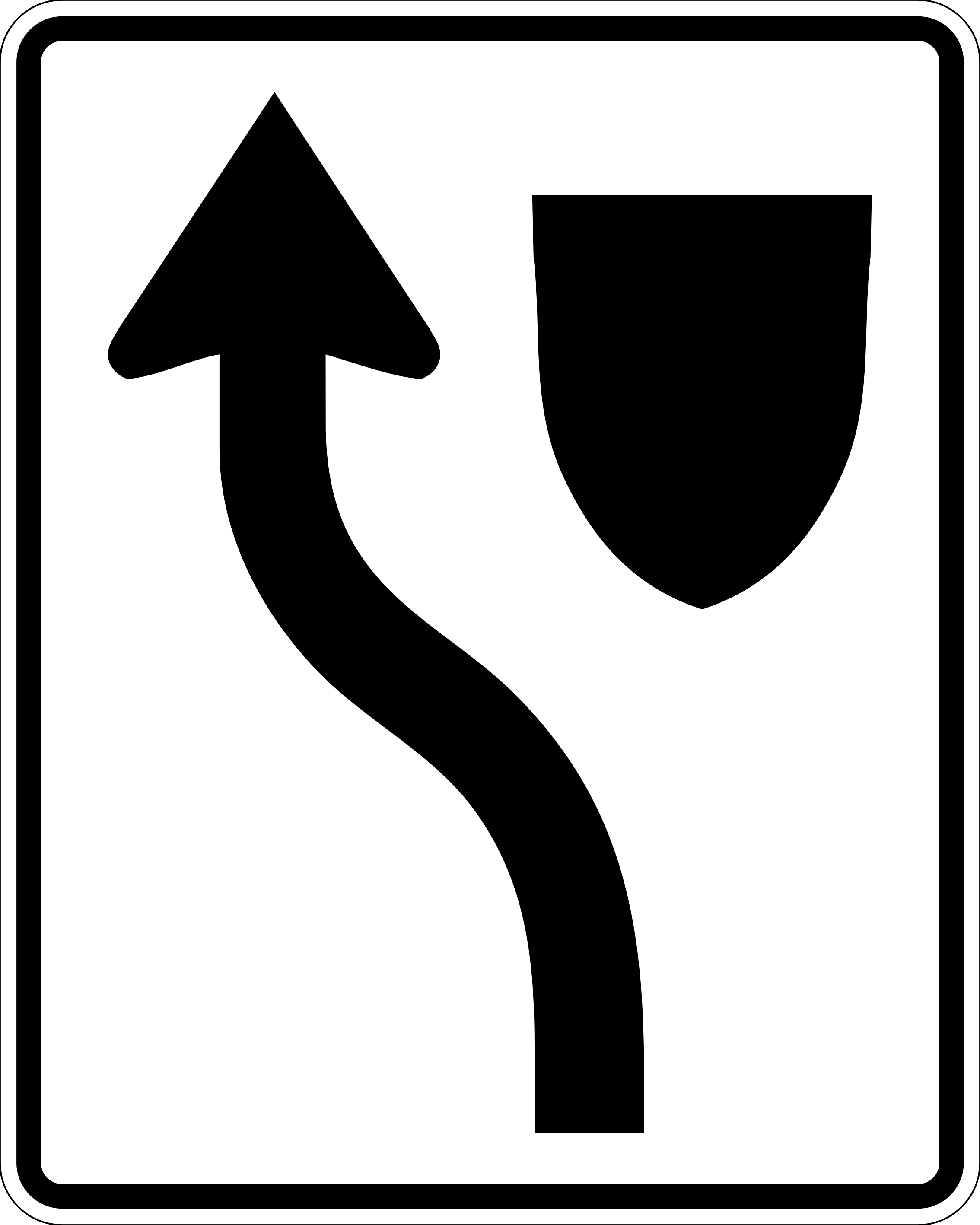
What does a black and white sign showing traffic passing to the left of a divider mean?
Answer: Keep left
A Keep Left sign directs drivers to pass to the left of a traffic island, median, or obstacle. It's a mandatory direction sign.
About 40% answer this correctly
On a divided road with a speed limit over 80 km/h, when is it legal to drive in reverse?
Answer: Only to help someone
It is illegal to drive in reverse on a divided road with a speed limit over 80 km/h, except to help someone in trouble.
About 45% answer this correctly
At what blood alcohol concentration (BAC) does a driver face criminal charges under Canada's Criminal Code?
Answer: 0.08%
Driving with more than 80 mg of alcohol per 100 mL of blood (0.08) is a criminal offence under the Criminal Code of Canada, resulting in criminal charges, licence suspension, and possible imprisonment.
About 45% answer this correctly
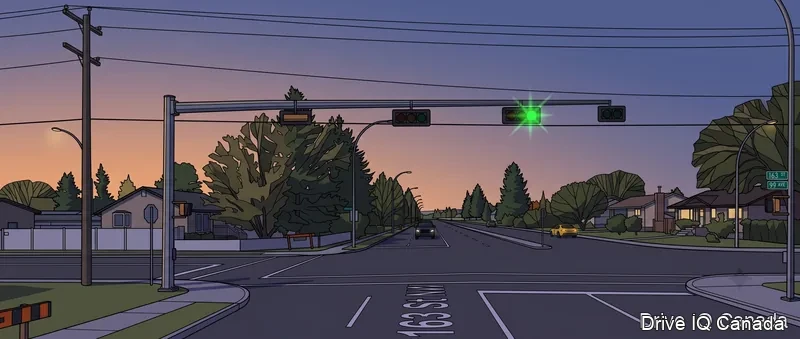
What does a flashing green light mean in Ontario?
Answer: Advanced green; oncoming has red
A flashing green light in Ontario means you have an advanced green. Oncoming traffic faces a red light, so you may turn left, go straight, or turn right.