Québec SAAQ Class 5 Knowledge Test Practice 2026
Three sections: the Highway Safety Code, road signs and signals, and driving behaviours and techniques. You need 75% in EACH section; the SAAQ does not publish the number of questions. Use these free practice tests to study the rules of the road, traffic signs, and Québec-specific laws before your appointment.
Readiness scoreTargets weak spots
Use Pro, reach an 80% IQ Readiness Score and still fail? We refund your plan. Conditions apply.
HOW WE HELP YOU PREPARE
297+ practice questions to help you master the Québec knowledge test, 4 practice runs that cover every topic, plus a full mock exam.
QUÉBEC REQUIREMENT TO PASS
Three sections: the Highway Safety Code, road signs and signals, and driving behaviours and techniques. You need 75% in EACH section; the SAAQ does not publish the number of questions. No published time limit.
Verified November 2026 by our editorial team from SAAQ Driver's Handbook. Rules change, so always confirm with the current official materials from Société de l'assurance automobile du Québec (SAAQ) before your test.
Use Pro, reach an 80% IQ Readiness Score and still fail? We refund your plan. Conditions apply.
Study by Category
Master each topic before your Québec written test. 4 categories are free to start.
Study your weak spots first
Practice Runs
Four runs that mix every topic on the test, like a short version of the real exam. Sets A to D never repeat a question. Two are free; two more with Pro.
- SAAQ Practice Test 3: All Topics, Set CProIncludes hill signs, curve and chevron signs and parking on hills, plus every other topic on the test. No repeats across Sets A to D.25 questions · ~15 minGet Pro
- SAAQ Practice Test 4: All Topics, Set DProIncludes rollover risk, keep-left and keep-right signs and pedestrians, plus every other topic on the test. No repeats across Sets A to D.25 questions · ~15 minGet Pro
Pro Study Tools
The full learning system, on the site and in the app.
- Québec SAAQ Exam Simulator 2026ProFull mock exam in the real test's format. Where the licensing authority publishes the length, pass mark and time limit, it uses them.Get Pro
- Quick SAAQ Practice QuizProQuestions drawn from your weak areas, randomised every time you open it. No two quizzes are the same.Get Pro
- Build a Custom TestProPick topics, difficulty and which questions to include.Get Pro
- IQ Readiness Score™ AnalysisProDetailed breakdown of your strengths, weak spots, and how ready you are.Get Pro
Related guide: Quebec's health questionnaire at 75 and assessment at 80.
Everything to know about the Québec SAAQ Knowledge Test
Quebec's knowledge test is administered by the Société de l'assurance automobile du Québec (SAAQ) and is structured differently from most other provinces. The test has three sections: the Highway Safety Code (rules and regulations), road signs and traffic signals, and driving behaviours and techniques. You must score at least 75% on EACH section independently, and if you fail a section you retake only that section. The SAAQ does not publish how many questions each section has.
The test is computer-based. It is available in French and English, and also in Modern Standard Arabic, Spanish and Mandarin, with audio in French and English. If you fail, the SAAQ requires a 28-day wait before you retake it. Stop signs in Quebec read ARRÊT; the SAAQ handbook notes that the word STOP may replace it.
To get a Class 5 learner's licence (permis d'apprenti conducteur) you must be at least 16 (with written parental consent if under 18; a moped or scooter licence is possible from 14 with written consent), enrol in the mandatory driving course at a recognized driving school, and pass Phase 1 of that course. You then drive accompanied, and you become eligible for the SAAQ knowledge test once you have held your learner's licence for at least 10 months.
Quebec's graduated system has three stages: learner's licence (apprenti), probationary licence (probatoire, 24 months), then the regular Class 5 licence. Learners may not drive between midnight and 5 a.m. Learner and probationary drivers face zero tolerance for alcohol and drugs and lose their licence at 4 demerit points (versus 8 to 15 for a regular licence, depending on age). Probationary drivers aged 19 or under may carry only a limited number of passengers aged 19 or under between midnight and 5 a.m. The road test comes after you have held the learner's licence for at least 12 months and finished the driving course; the course is mandatory and does not shorten the wait.
Quebec has several rules worth knowing. Right-on-red is permitted in most of the province but not on the Island of Montreal. Winter tires are mandatory on Quebec-registered passenger vehicles from December 1 to March 15. Zero alcohol tolerance also applies to every driver aged 21 or under, whatever the licence stage.
Brushing up on Canadian road signs? Our sign-specific practice covers every regulatory, warning, and information sign you'll see on the test.
Québec: rules to know
Quebec's most distinctive rule is that right-on-red is prohibited on the entire Island of Montreal, even after a complete stop. Stop signs say ARRÊT (not STOP). Winter tires are mandatory on passenger vehicles from December 1 to March 15. Drivers under 22 face zero blood-alcohol concentration regardless of licence stage. The knowledge test is also the only one in Canada split into three independently graded sections, with a 28-day wait after a fail.
Key points for Québec
Quebec licensing runs through the learner, probationary and full licences. The learner licence lasts a minimum of 12 months, then the probationary licence lasts 24 months, before the full driver's licence. The learner licence is valid for 18 months; if you have no probationary licence by then, you can request a new learner licence, valid for 12 months. The 24 months of probationary experience only accumulate while the licence is valid. The exams follow a timetable too: the theory exam requires a learner licence held at least 10 months, and the practical exam one held at least 12 months.
In Quebec the driving course comes before the licence. It is taken at a SAAQ-recognized driving school: the Road Safety Education Program has four learning phases that alternate theory modules and on-road outings. Before the learner licence you must complete the 4 modules of phase 1 (each has a 2-hour classroom part) and pass the driving school's own theory evaluation, module 5. You must also pass the SAAQ vision test and complete the medical declaration of illness or functional deficit. You need Canadian citizenship or a right of stay in Canada of more than 6 months, and your main residence in Quebec.
The probationary licence carries specific rules. Tolerance is zero: no trace of alcohol or drugs in the blood, and the holder may not supervise another person learning to drive. Between midnight and 5 a.m., a holder aged 19 or under may carry one passenger aged 19 or under with 6 months or less experience, and up to 3 between 6 and 12 months; immediate family is not counted. The limits do not apply after 12 months or when an accompanier with 2 years of licence sits in front. The demerit point limit is 4 for learner and probationary holders, against 8 to 15 points for the full licence depending on age.
For the practical exam the SAAQ provides no vehicle: you bring a safe vehicle in good mechanical condition, with no passenger or animal on board. Failing to make a mandatory stop, speeding or driving against traffic can cause immediate failure. The exam lasts about 30 minutes. On the SAAQ 2026 schedule (non-refundable, administration and photo fees included) it costs $33.75, and late cancellation $26.75. After a failure the minimum wait before retaking is 28 days, and you must hold the driving school completion certificate for all phases.
Try it yourself
Get a taste of the study experience. Answer a real question or preview the timed exam simulator.
Sample flash card
Is it legal to drive after consuming cannabis in Quebec?
Try all free practice runs
Start practicingWhen approaching a school zone during posted hours, the maximum speed limit in Québec is:
Exam Simulator
Full 64-question mock exam. The length is our practice length; the number of questions is not published. Pass mark: 75% in each of 3 sections. No published time limit.
Know how ready
you are for the Québec test
The IQ Readiness Score™ measures six dimensions of test readiness and shows how ready you are for the Québec exam, from 0 to 100%.
View full readiness reportFrequently Asked Questions
The test has three sections: the Highway Safety Code, road signs and signals, and driving behaviours and techniques. You need 75% in each section, and the SAAQ does not publish the number of questions. If you fail, you retake only the section or sections you failed.
You must wait 28 days from the day of the failure, and you pay C$13.50 again for every attempt, with no free retest. Ordinary repeated failure does not lengthen the wait. Only cheating does: 90 days before a retake, and 180 days for a repeat offence.
The exam fee is C$13.50 (the 2026 rate), charged per appointment, and it covers one or more exams taken at the same appointment. It is a separate fee and is not bundled into a licence package. The permis d'apprenti conducteur is charged separately.
Yes. The compulsory SAAQ driving course is 39 hours: a 24-hour theory component in 12 modules and a 15-hour on-road component with an instructor. It is required of every new Class 5 driver, there is no exempt path, and it does not shorten the licensing timeline.
You must be 16, with written parental consent if you are under 18, and you must be enrolled in the mandatory driving course first. Quebec has three licence stages: the permis d'apprenti conducteur (learner), the permis probatoire (probationary) and the full class 5 licence.
At least 36 months. You hold the permis d'apprenti conducteur for a minimum of 12 months before the road test, then the permis probatoire for 24 months. Nothing shortens this, because the driving course is mandatory for everyone. The earliest full licence comes at about age 19.
French and English, plus Modern Standard Arabic, Spanish and Mandarin. Audio recordings of the questions are available only in French and English, and an interpreter can assist on request. If you test in another language, the road test requires a rental vehicle with two sets of pedals.
Zero alcohol applies to every learner and probationary driver, and to any driver aged 21 or under. Learner permit holders under 20 may not drive between midnight and 5 a.m. Probationary drivers aged 19 or under may carry one passenger aged 19 or under between midnight and 5 a.m. for the first 6 months, then up to 3 for the next 6 months.
Your accompanier must have held a valid licence for a passenger vehicle for at least two years and sit beside you. A holder of a probationary licence cannot act as accompanier. A learner must always be accompanied, and driving is forbidden between midnight and 5 a.m. and after consuming alcohol or drugs.
No. Merely holding a device is presumed to be using it, whether activated or not, including at a red light or in traffic. Browsing the web or reading email or texts is banned, even on the vehicle's built-in screen. The fine is $300 to $600 for a first offence and $600 for a repeat, with 5 demerit points. Emergency 911 calls and contactless payment are allowed.
At 4 or more demerit points a learner or probationary licence is revoked, and a new one cannot be obtained for at least 3 months. Speeding 11 to 20 km/h over the limit costs 1 point and 21 to 30 km/h over costs 2 points, in every zone type.
The learner licence costs $88.35 (valid 18 months, photo included). The probationary licence costs $107.96, the amount for 24 months. Credit cards are not accepted at service points, so plan another way to pay.
It depends on where your licence was issued. Québec exchanges licences from some countries with no road test, credits your driving experience in others, and requires the full test for the rest.
See Québec's licence exchange rulesMost missed free practice questions in Québec
These free questions have the lowest first-answer scores among learners who tried them. Shares are rounded to the nearest 5 percent.
About 40% answer this correctly
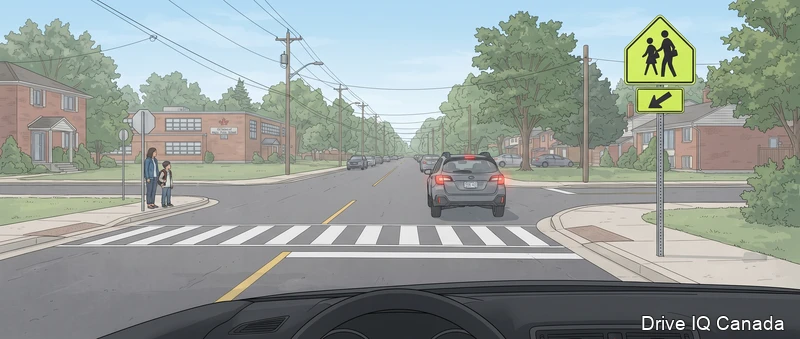
In Quebec, what is the maximum speed limit in a school zone when it is in effect?
Answer: 50 km/h
Between September and June the maximum in a Quebec school zone is 50 km/h, Monday to Friday during posted hours, unless a lower limit is signed. The 30 km/h figure is Quebec's bicycle boulevard limit, not its school zone limit.
About 45% answer this correctly
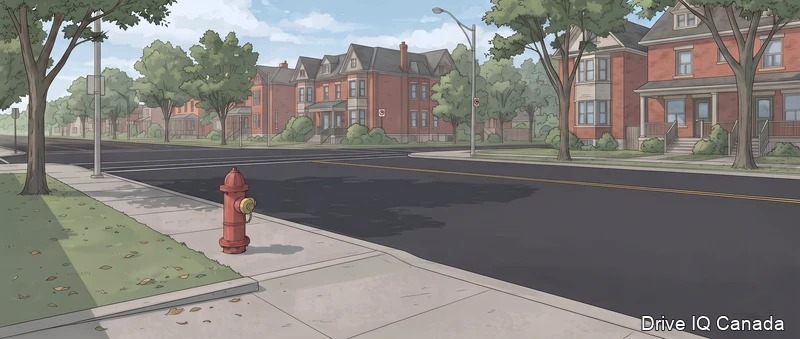
In Quebec, how far from a fire hydrant must you park?
Answer: 3 metres
Quebec prohibits parking or stopping less than 3 metres from a fire hydrant. The 5-metre figure in the same list applies to an intersection, crosswalk, bicycle crossing or level crossing, and to a police or fire station.
About 55% answer this correctly
How many demerit points are assigned for speeding 21 to 30 km/h over the limit in Quebec?
Answer: 2 points
Speeding 21 to 30 km/h over the limit results in 2 demerit points.
About 55% answer this correctly
In Quebec, how many demerit points apply for exceeding the speed limit by 61 to 80 km/h?
Answer: 14 demerit points
Exceeding the limit by 61 to 80 km/h carries 14 demerit points, and unusually it is the same in every speed zone. The 18-point figure begins at 81 km/h over. This range is also excessive speeding, which carries its own penalties.
About 55% answer this correctly
In Quebec, how many demerit points apply for exceeding the limit by 46 to 49 km/h in a zone of 60 km/h or less?
Answer: 10 demerit points
Quebec's demerit table depends on the posted zone as well as the amount over the limit. Exceeding the limit by 46 to 49 km/h is 10 demerit points in a zone of 60 km/h or less, but 5 points in faster zones.