New Brunswick Class 7 Knowledge Test Practice 2026
Two separate tests. The rules of the road test has 20 questions and you need 16 correct (80%). The sign recognition test requires the stop, yield and school zone signs correct and no more than four errors on the rest. Use these free practice tests to study the rules of the road, traffic signs, and New Brunswick-specific laws before your appointment.
Readiness scoreTargets weak spots
Use Pro, reach an 80% IQ Readiness Score and still fail? We refund your plan. Conditions apply.
HOW WE HELP YOU PREPARE
272+ practice questions to help you master the New Brunswick knowledge test, 4 practice runs that cover every topic, plus a full mock exam.
NEW BRUNSWICK REQUIREMENT TO PASS
Two separate tests. The rules of the road test has 20 questions and you need 16 correct (80%). The sign recognition test requires the stop, yield and school zone signs correct and no more than four errors on the rest. No published time limit.
Verified November 2026 by our editorial team from New Brunswick Driver's Handbook. Rules change, so always confirm with the current official materials from Service New Brunswick (SNB) before your test.
Use Pro, reach an 80% IQ Readiness Score and still fail? We refund your plan. Conditions apply.
Study by Category
Master each topic before your New Brunswick written test. 4 categories are free to start.
Study your weak spots first
Practice Runs
Four runs that mix every topic on the test, like a short version of the real exam. Sets A to D never repeat a question. Two are free; two more with Pro.
- Class 7 Practice Test 3: All Topics, Set CProIncludes hydroplaning, scanning ahead and the supervising driver, plus every other topic on the test. No repeats across Sets A to D.25 questions · ~15 minGet Pro
- Class 7 Practice Test 4: All Topics, Set DProIncludes right turns on red, belt fit and the graduated licence, plus every other topic on the test. No repeats across Sets A to D.25 questions · ~15 minGet Pro
Pro Study Tools
The full learning system, on the site and in the app.
- New Brunswick Class 7 Exam Simulator 2026ProFull mock exam in the real test's format. Where the licensing authority publishes the length, pass mark and time limit, it uses them.Get Pro
- Quick Class 7 Practice QuizProQuestions drawn from your weak areas, randomised every time you open it. No two quizzes are the same.Get Pro
- Build a Custom TestProPick topics, difficulty and which questions to include.Get Pro
- IQ Readiness Score™ AnalysisProDetailed breakdown of your strengths, weak spots, and how ready you are.Get Pro
Everything to know about the New Brunswick Class 7 Knowledge Test
New Brunswick's knowledge test is administered by Service New Brunswick (SNB) at any of its service centres. There are two separate written tests, road sign recognition and rules of the road, and you must pass each one; if you fail one, you retake only that test. The rules test has 20 questions and you need 16 correct (80%). The sign test requires you to identify the stop, yield and school zone signs correctly and make no more than four errors on the rest. No time limit is published, and the test is offered in both English and French.
After passing, you receive a Class 7 Level 1 graduated licence. You can take the road test for Level 2 after 12 months, or after 8 months if you graduated from a licensed driver training school. Level 2 lasts at least 12 more months, and you then apply for your Class 5 licence; there is one road test on this path.
Level 1 drivers must have only one passenger, a driver with a Class 5 or better licence and at least three years of driving experience, seated in the front, and cannot drive between midnight and 5 a.m. Level 2 drivers may carry no more than three passengers, only one in the front, and if under 21 cannot drive between midnight and 5 a.m. except for school or work or with an experienced driver. Zero tolerance for alcohol and drugs applies at both levels. Using a hand-held electronic device while driving is prohibited for every driver.
The driver's handbook is published in parallel English and French editions, and you can take the test in your preferred official language.
The handbook covers driving in rain, sleet, snow, ice and fog, and warns that animal crossing signs mark where moose and deer are known to cross, especially at dawn and dusk.
Brushing up on Canadian road signs? Our sign-specific practice covers every regulatory, warning, and information sign you'll see on the test.
New Brunswick: rules to know
New Brunswick is officially bilingual; the handbook and the test are available in both English and French. Using a hand-held electronic device while driving is prohibited for every driver. Level 2 drivers under 21 cannot drive between midnight and 5 a.m. except for school or work or with an experienced driver. Studded tires are permitted from October 15 to April 30.
Key points for New Brunswick
In New Brunswick, Class 7 holders must keep 0 per cent blood alcohol and must not use impairing drugs, and every motorist under 21 must also keep 0 per cent while driving. A zero tolerance programme covers drug-impaired driving for novice drivers and those under 21. A breach by a Class 7 holder brings a one year suspension and a return to the start of the graduated period, with no credit for tests or driver training already passed. A novice driver who breaks the rule also faces a mandatory seven-day vehicle impoundment.
A driver licensed for less than four years is credited four points on licensing, and two more each subsequent year to a maximum of 10. Losing all points brings a suspension. For a graduated licence holder that means at least a three month suspension, then a return to the beginning of the graduated licence period with no credit for earlier tests or courses. Demerit points are returned two years after the conviction date. As an example from the handbook, distracted driving carries 5 demerit points.
New applicants must visit a Service New Brunswick Centre, where a new photo is required. A 30-day temporary document is issued on application, and the new licence arrives by mail about 14 days later. As of 1 August 2026 (gnb.ca), a Class 1-9 licence valid for four years costs $100, and renewal for Classes 9, 8, 7 and 5 is $100 every four years. A licence expires on the licensee's birthday in the year of expiry, and a change of address or name must be reported to the Motor Vehicle Branch within ten days.
Road test appointments can only be booked through Service New Brunswick Teleservices at 1-888-762-8600. The examination runs over a course of at least 3 km and, when possible, in fairly dense traffic, and includes stopping and starting on a level road and on a hill. It will not be conducted if the vehicle is not in satisfactory mechanical condition. The Class 9, 7, 6 or 5 road test costs $25 for each attempt (as of 1 August 2026). All test results are valid for only six months, so expired tests must be redone if a licence is not issued in time.
Try it yourself
Get a taste of the study experience. Answer a real question or preview the timed exam simulator.
Sample flash card
At what BAC can New Brunswick police issue a provincial administrative suspension?
Try all free practice runs
Start practicingWhen approaching a school zone during posted hours, the maximum speed limit in New Brunswick is:
Exam Simulator
Full 40-question mock exam. The length is our practice length; the number of questions is not published. Pass mark: Rules test 16 of 20 (80%), sign test separate. No published time limit.
Know how ready
you are for the New Brunswick test
The IQ Readiness Score™ measures six dimensions of test readiness and shows how ready you are for the New Brunswick exam, from 0 to 100%.
View full readiness reportFrequently Asked Questions
There are two separate tests. The rules of the road test has 20 questions and you need 16 correct (80%). The sign recognition test requires the stop, yield and school zone signs correct and no more than four errors on the rest.
Two official sources differ. Service New Brunswick's online test rules require a 1-day wait after a first fail and 1 week after a second; after three fails you must test in person. gnb.ca says there is no waiting period to retake a test. Confirm with Service New Brunswick when you book. A retest is bought only for the test you failed.
The written test costs C$25 for a first attempt, and a written re-write costs C$15 (Service New Brunswick fees as of August 1, 2026).
Yes. The Road Sign Recognition and Rules of the Road exams can be taken online with online payment, or in person at a Service New Brunswick office. Written tests can also be delivered orally, and those appointments can be booked by telephone through SNB Teleservices.
Testing is available in both official languages, English and French. No third-language testing and no interpreter policy is published, so ask Service New Brunswick before your appointment if you need another arrangement.
You may apply at 16, with parental consent if you are under the age of majority. The program runs through Class 7 Level 1 (marked with an L on the licence), Class 7 Level 2, then the full Class 5 licence.
Level 1 lasts 12 months, or 8 if you complete a licensed driving-school course, and Level 2 lasts at least 12 months, so the program takes 24 months or 20 with the course. One road test moves you to Level 2, and gnb.ca says no road test is needed for the Class 5.
Zero tolerance for drugs or alcohol applies at both levels. At Level 1 the only passenger allowed is the supervising driver, who is licensed 3 or more years, and midnight to 5 a.m. driving is barred. At Level 2 you may carry up to 3 passengers, only one in front, and the curfew applies until age 21 with exceptions.
The minimum age for a Class 7 Graduated Licence is 16, and applicants under 18 need a parental consent form witnessed by a non-relative. The written parental or guardian consent can be withdrawn at any time before age 18 by written application to the Registrar of Motor Vehicles, who may then cancel the licence.
The handbook gives metric and imperial measures, but the written test refers only to the metric system, so learn distances in metres. A Class 7 applicant must also pass vision screening at 20/40 with the best eye.
When an emergency or service vehicle is stopped on the highway with its flashing lights on, slow down to one half the posted speed limit. Separately, it is an offence to follow an emergency vehicle within 150 metres (500 feet), and the handbook also bars following, driving or parking within 150 metres of fire apparatus responding to or stopped at an alarm.
Unless a sign says otherwise, a right turn may be made on a red light after a full stop, yielding to pedestrians and other traffic. A flashing green traffic light is an advance green meaning you can turn left if it is safe.
It depends on where your licence was issued. New Brunswick exchanges licences from some countries with no road test, credits your driving experience in others, and requires the full test for the rest.
See New Brunswick's licence exchange rulesMost missed free practice questions in New Brunswick
These free questions have the lowest first-answer scores among learners who tried them. Shares are rounded to the nearest 5 percent.
About 45% answer this correctly
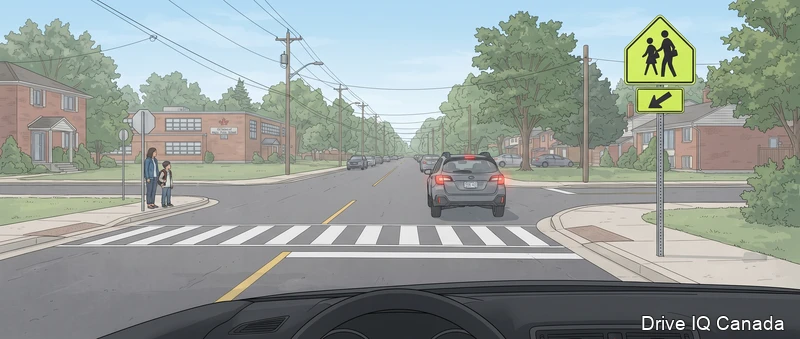
What is the school zone speed limit in an urban district in New Brunswick on school days?
Answer: 50 km/h
In New Brunswick the school zone speed limit is 50 km/h in an urban district unless a different speed is posted. It is in effect from 7:30 a.m. to 4:00 p.m. on days when school is in session.
About 50% answer this correctly
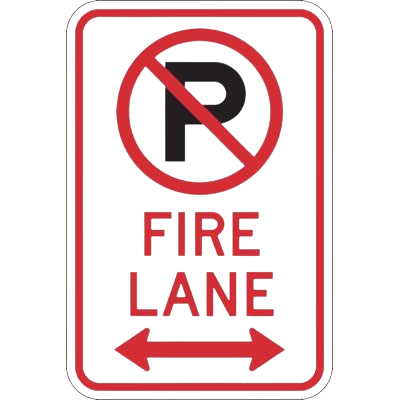
What does a sign marked 'FIRE ROUTE, NO PARKING' indicate?
Answer: Keep clear for fire trucks
Fire route signs designate roads that must remain clear for emergency fire vehicle access. Parking is prohibited at all times and vehicles will be towed.
About 60% answer this correctly
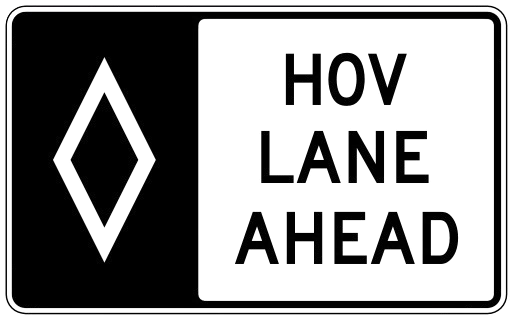
What does a diamond-shaped lane marking and a green sign showing 'HOV' or a diamond symbol indicate?
Answer: A high-occupancy (HOV) lane
HOV (carpool) lanes reduce congestion by encouraging ride-sharing. The diamond symbol on the road and signs indicates the reserved lane. Penalties for single-occupant use are significant.
About 60% answer this correctly
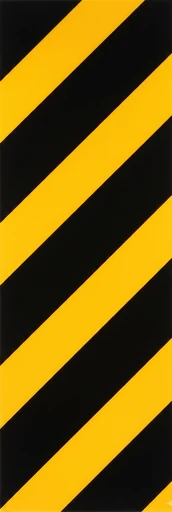
You see a marker with black and yellow stripes that slope down to the left. What does it tell you?
Answer: There is an obstruction; keep to the left of the marker
This hazard marker warns of an obstruction close to the road. The stripes slope down toward the side you should pass, so keep to the left of it.