School bus rules across Canada: the question almost everyone gets wrong
Rules and penalties below come from each province's official driver handbook: the MTO Driver's Handbook (Ontario), the SAAQ Driver's Handbook (Quebec), ICBC's Learn to Drive Smart (British Columbia), Alberta's Driver's Guide: Cars and Light Trucks, and MPI's Driver's Handbook (Manitoba). Where a handbook gives no figure, we say so instead of filling the gap from another site. Fines change often.
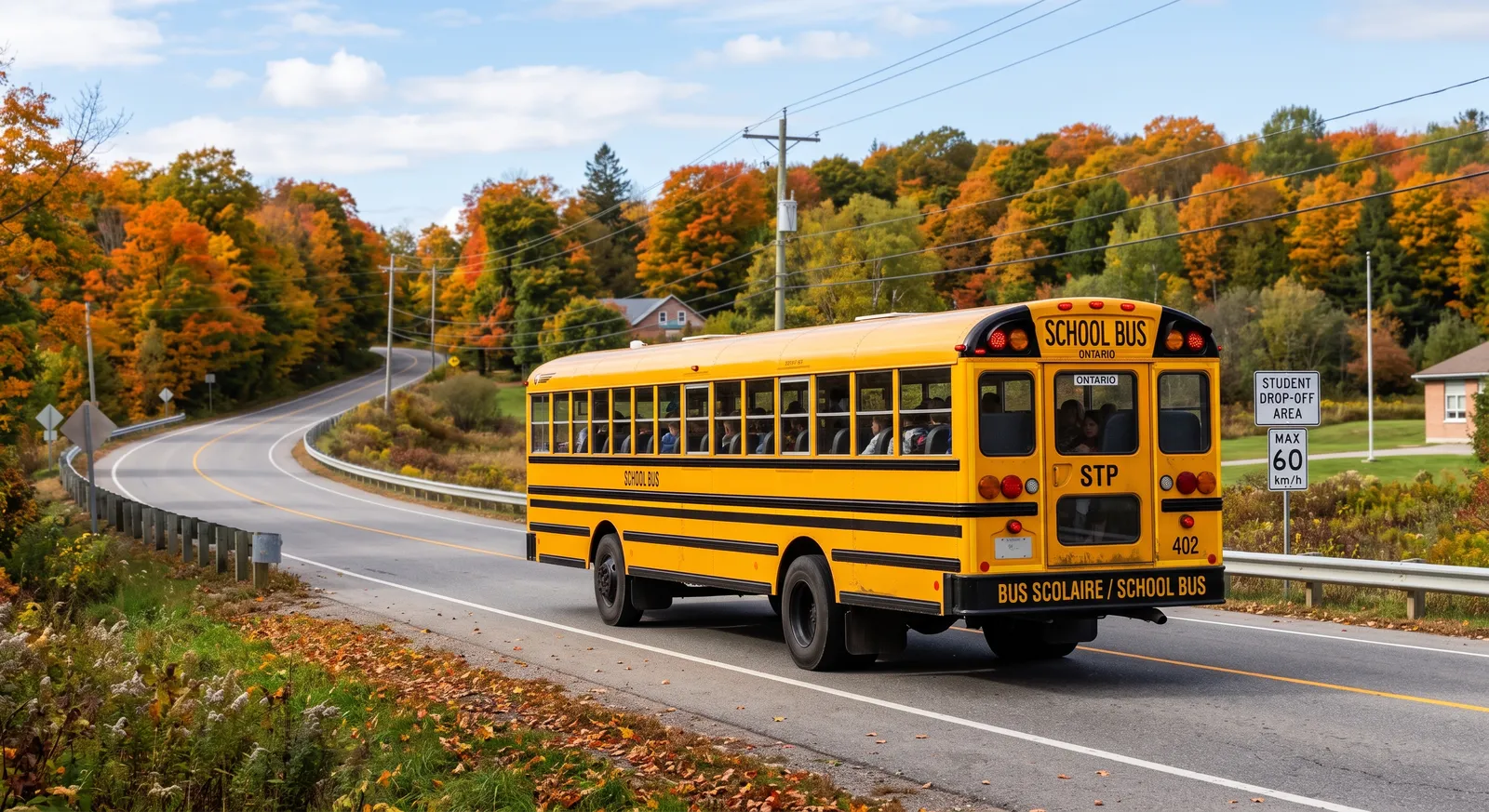
There is one road rule that catches out more new drivers, and more experienced ones, than almost anything else on a Canadian knowledge test. It sounds simple. A school bus stops ahead of you, its upper red lights flashing and its stop arm swung out. You stop. Everyone knows that part.
The part people get wrong is the bus coming toward you, on the other side of the road. Do you stop too?
On most roads, yes. And that is the answer a large share of test-takers, and drivers, get backwards.
The rule in one sentence
On an undivided road, you must stop for a school bus with its red lights flashing no matter which direction you are travelling, whether you are behind it or approaching it head-on. On a divided highway (one split by a raised, lowered, or physical median), traffic on the opposite side of the median does not have to stop in Ontario, Quebec, Alberta and Manitoba. British Columbia's handbook states no such exception.
That is the whole trap. People assume "the other side of the road" always means "not my problem." It usually is your problem. The exception is narrower than most people think: it applies only when there is an actual physical median between you and the bus. A painted centre line, even a double solid yellow one, is not a median. If the only thing separating you from the bus is paint, you stop.
This distinction is why the topic shows up so often on knowledge tests. It is a clean way to separate drivers who memorized "stop for the bus" from drivers who understand *why*. Children cross in front of a stopped bus. A driver coming the other way on a two-lane road is exactly the car that would hit them.
What "divided" actually means
Read a test question carefully and the answer is usually hiding in one or two words.
- If the question says "divided highway" or mentions a "median" or "physical barrier," the opposite-direction traffic is exempt (outside British Columbia, whose handbook names no exception).
- If it says "two-lane road," "road with a centre line," "undivided," or gives no divider at all, you stop from both directions.
- The number of lanes does not decide it. A wide multi-lane road with no median still counts as undivided, and you stop both ways.
This is also worth getting right off the test, because the penalties for missing it are steep.
Province-by-province comparison
In four of these five provinces the handbook states the same core rule: stop both ways unless a median divides you. British Columbia's handbook states only that you stop from the front or the rear and that vehicles in all lanes must stop, with no median exception. The stopping distance and the penalties differ too. Here is what each handbook says.
| Province | Undivided road | Divided highway (physical median) | Minimum stop distance | Fine (first offence) | Demerit / penalty points |
|---|---|---|---|---|---|
| Ontario | Stop from both directions | Only vehicles behind the bus stop | At least 20 m when coming from behind; from the front, far enough for children to cross | A heavy fine (the handbook gives no amount) | 6 |
| Quebec | Stop from both directions | The obligation does not apply across a median or other divider | More than 5 m | C$200 to C$300 | 9 |
| British Columbia | Stop from the front or the rear; vehicles in all lanes stop | The handbook states no median exception | No distance in metres | Not stated in the handbook | Not stated in the handbook |
| Alberta | Stop from either direction | Vehicles behind the bus stop | About 20 m (four to five car lengths) | Not stated in the guide | Not stated in the guide |
| Manitoba | Stop from either direction | Opposite direction need not stop across a physical median or ditch | At least 5 m | A large fine (the handbook gives no amount) | No demerit points: you move down the Driver Safety Rating scale |
A few things stand out.
Quebec hands out the most points of the five. Nine demerit points for one offence, with a fine of C$200 to C$300. For a new driver in Quebec, a learner or probationary licence is revoked at four demerit points, so a single violation is enough to lose it.
Ontario adds owner liability. Six demerit points for a first offence, and school bus drivers and other witnesses can report a vehicle that passes illegally. If you are the registered owner, the fines (but not the demerit points or jail time) can be applied to you even if you were not driving.
Manitoba does not use demerit points for this. Passing a stopped school bus illegally brings a large fine and moves you down the Driver Safety Rating scale, which is how Manitoba tracks driving offences.
The stopping distance is not uniform. Ontario wants you at least 20 metres back when you come from behind. Alberta says about 20 metres, or four to five car lengths. Quebec and Manitoba use 5 metres. British Columbia's handbook gives no figure in metres, so the practical rule there is to stop far enough back that children have clear, safe room to cross.
What the handbooks leave out
None of the five handbooks states every penalty. Ontario's and Manitoba's describe the fine without an amount, and British Columbia's and Alberta's give neither a fine nor points for this offence. We have left those cells as "not stated" rather than fill them from news articles or driving-school pages, which often quote different figures for the same province. Check your provincial authority's current fine schedule before you rely on a number.
Why this one question is worth studying
If you want a single indicator of whether someone actually prepared for the knowledge test or just skimmed, this is it. The school bus questions are not hard. They reward reading carefully (divided versus undivided) and knowing that a painted line is not a barrier. That is exactly the kind of detail our breakdown of the hardest G1 questions keeps coming back to: the test is easy if you study, and a lot of people don't, then blame the test.
Learn the rule once and it carries across these provinces, with the distance and the penalty changing between them, and British Columbia's handbook asking you to stop in all lanes.
Frequently asked questions
Do you have to stop for a school bus coming from the other side of the road?
On an undivided road, yes, in every province covered here. You stop whether you are behind the bus or approaching it from the opposite direction. Ontario, Quebec, Alberta and Manitoba make an exception for a divided highway with a physical median between you and the bus; British Columbia's handbook states none. A painted centre line does not count.
What counts as a divided highway for school bus rules?
A road split by a raised, lowered, or otherwise physical median or barrier. On such a road, traffic on the far side of the median is not required to stop. A double solid yellow line, or any painted marking, is not a median, so you must still stop.
How far back do you have to stop for a school bus?
It depends on the province. Ontario requires at least 20 metres when you come from behind the bus, and Alberta says about 20 metres. Quebec and Manitoba require at least 5 metres. British Columbia's handbook gives no fixed distance, so stop far enough back to leave children a clear, safe path to cross.
What is the fine for passing a stopped school bus?
Of the five handbooks, only Quebec's states an amount: C$200 to C$300. Ontario's and Manitoba's describe a heavy or large fine without a figure, and British Columbia's and Alberta's give none. Fines change often, so confirm the current amount with your provincial authority before you rely on it.
How many demerit points do you get for not stopping for a school bus?
Quebec 9 and Ontario 6. Manitoba uses its Driver Safety Rating scale instead of demerit points, and the British Columbia and Alberta handbooks do not state a figure. Quebec's nine points is enough on its own to cost a new Quebec driver their licence.
When can you legally pass a school bus?
Once the red lights have stopped flashing and the stop arm has folded back in, and only where passing is otherwise permitted. While the red lights flash and the stop arm is out, you wait, regardless of how long it takes.
Ready to start studying?
Work through real Canadian practice questions with instant explanations, and track your readiness before you book.
Start a free Ontario practice testFree practice tests for every province and territory