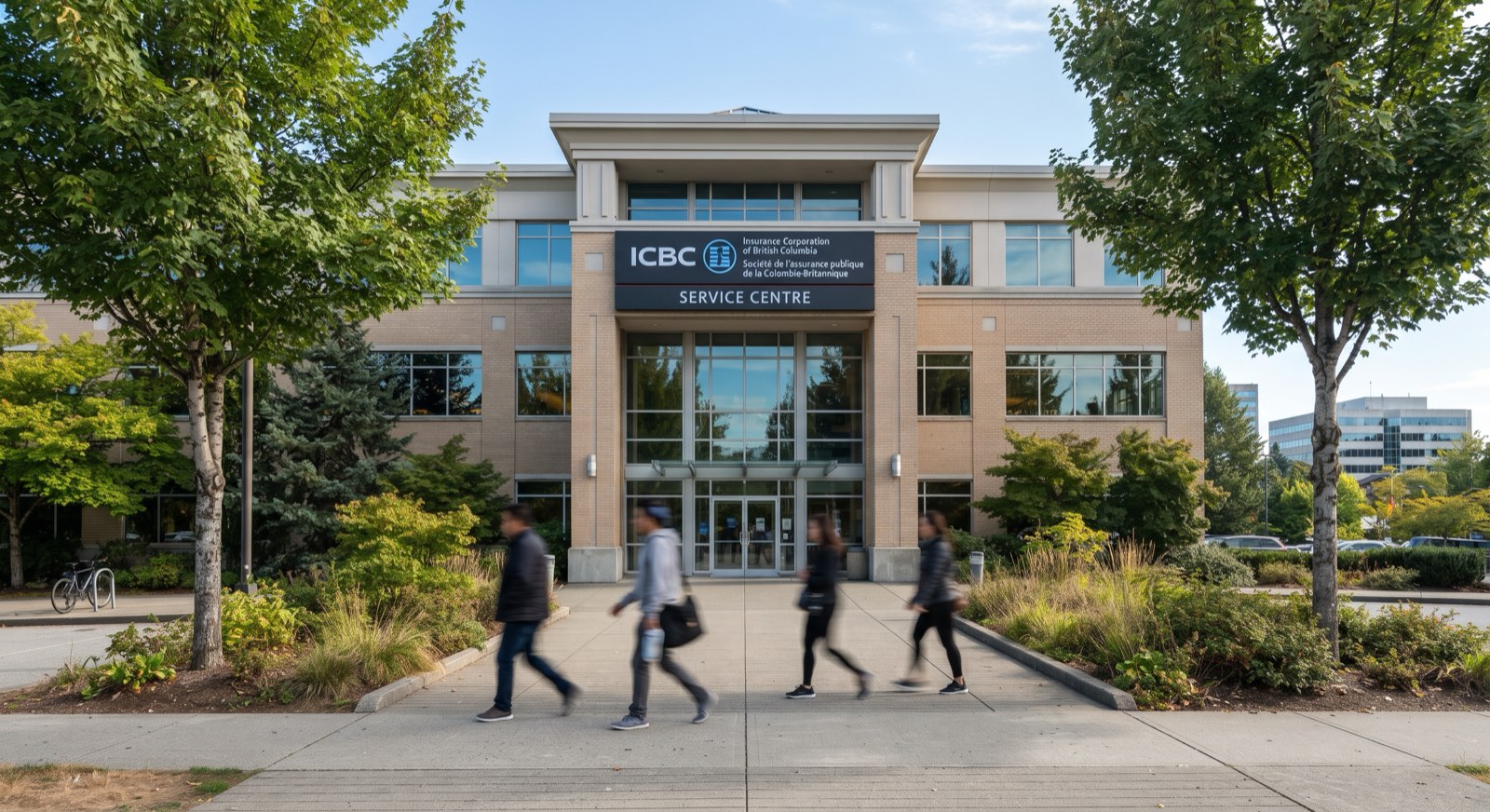
British Columbia Class 7L Numbers Cheat Sheet: What ICBC Now Says
The sheet has 79 rows. Each was checked against ICBC's *Learn to Drive Smart* guide and web pages, and against the Motor Vehicle Act and the Violation Ticket Administration and Fines Regulation on bclaws.gov.bc.ca. No driving school, forum or prep site was used.
The biggest surprise is the supervisor. ICBC's current English guide and its Get your L page say a learner's supervisor must be 22 or older. Our question bank, and a July copy of the guide, still said 25. The sheet shows 22. The live French guide still prints 25, so if you study from it, trust the English edition and ICBC's website.
The road to a full licence has also changed. Since October 19, 2026, a Driving Record Assessment replaces the second road test. You hold the learner stage for 12 months if you are under 25 or 9 months if you are 25 or older, then the novice stage for 24 months under 25 (18 with an approved GLP course) or 12 months at 25 or older. Our bank only covered the under-25 case, and the sheet now shows both.
The learner passenger limit has a catch too. It is one passenger besides your supervisor, and immediate family do not count. Our bank's answer ("two: supervisor plus one") leaves that out.
For penalties, BC uses the term penalty points. ICBC's lookup lists two "fail to yield to a pedestrian" lines, 3 points under s. 179 (1) and 2 points under s. 127 (1) (a) (ii). We kept the handbook's 3. The handbook's own table adds up to 21 points, yet its text says 17, so we did not publish 17. Excessive speeding is "more than 40 km/h over" in the Act, while the handbook says "40 km/h or more". The 7 day impoundment is the same either way.
Honest limits: 19 rows rest on one official source, and each says why. The RoadSafetyBC pages could not be reached from our systems, so none of the rows cites them. No row was dropped for lack of a source, but two figures that circulate online, a review referral at 50 points and a premium trigger of four points in 12 months, are not published because we found no official statement of them and our bank does not test them.
Once the figures are in your head, check them against real questions in the free British Columbia practice test.
British Columbia Class 7L (Learner), Graduated Licensing Program · Numbers reference
Every number the British Columbia Class 7L (Learner), Graduated Licensing Program knowledge test can ask you for, in one place, checked against the official sources and built to print.
Showing all 79 numbers
Speed limits and defaults
7 numbers| Value | Rule |
|---|---|
| 80 km/h | Default speed limit outside a municipality with no sign postedInside a municipality the default is 50 km/h. A posted sign always wins. |
| 30 km/h | Speed limit in a signed school zoneWhere signs show a 30 km/h limit. The sign tab can set other hours, but they cannot start later than 8 a.m. or end earlier than 5 p.m. |
| 8 a.m. to 5 p.m. on school days | Hours a signed school zone limit appliesOr the hours shown on the sign. |
| Dawn to dusk, every day | Hours a signed playground zone 30 km/h limit appliesNot limited to school days. |
| 70 km/h if the limit is 80 km/h or more; 40 km/h if it is under 80 | Top speed when passing a stopped vehicle with flashing lightsApplies in both directions. It does not apply when you approach from the opposite direction on a divided highway or laned roadway. Where signs show under 40 km/h, drive at the posted speed. |
| 60 km/h or lower | Roads where you must yield to a signalling transit bus pulling outOnly for a bus showing a yield-to-bus sign that has signalled and is moving from a stop. |
| 24 hours a day | Hours posted construction zone speed limits applyApplies when posted. Obey the signs and traffic control persons from the start to the end of the zone. |
Distances and following gaps
15 numbers| Value | Rule |
|---|---|
| At least 2 seconds | Following distance in good weather and road conditionsGuidance, not a number written into the Motor Vehicle Act. The Act only says not to follow more closely than is reasonable and prudent. |
| 4 seconds | Following distance in bad weather or on uneven or slippery roadsThe handbook uses 3 seconds on high-speed roads and 4 seconds in bad weather or on uneven or slippery roads. |
| At least 3 seconds | Following distance behind a vehicle on an unpaved road with dust or gravel |
| At least 3 seconds | Following distance behind a motorcycle |
| At least 12 seconds ahead | How far ahead to scan the roadAbout one to two blocks in the city and half a kilometre on the highway. |
| Every 5 to 8 seconds | How often to check your mirrors |
| 150 m | Distance of clear view required before a U-turn near a hill crestA U-turn is banned on or near a crest where you cannot be seen within 150 m. It is also banned on a curve, where a sign prohibits it, at an intersection with a signal, and in a business district except at an intersection with no signal. |
| 150 m | Closest you may follow fire apparatus responding to an alarmThe statute also bars driving or parking within 150 m of where fire apparatus has stopped at an alarm. |
| At least 1 m | Minimum space when passing a cyclist or pedestrianOn a road with a limit above 50 km/h the minimum is 1.5 m. On a sidewalk or in a protected cycle lane it is 0.5 m. |
| At least 1.5 m | Minimum space when passing a cyclist on a road with a limit above 50 km/h |
| From 30 minutes after sunset to 30 minutes before sunrise | When headlights must be onAlso any time objects on the road are not clearly visible at 150 m, for example in fog or heavy rain. |
| 150 m | Distance at which you must dim high beams for another vehicleApplies to oncoming and to followed vehicles. |
| 5 vehicles | Number of vehicles a slow vehicle may hold up before it must use a pulloutWhere the highway sign says slow traffic delaying 5 vehicles must use the pullout. |
| At least twice the normal braking distance | Braking distance to allow on wet roads |
| More than half a metre | Depth of moving water that can carry a car away |
Parking prohibitions
6 numbers| Value | Rule |
|---|---|
| 5 m | Closest you may park to a fire hydrantMeasured from the point on the curb or edge of the roadway closest to the hydrant. |
| 6 m | Closest you may park to a crosswalkThe statute bars parking on a crosswalk and within 6 m on its approach side. |
| 6 m | Closest you may park to a stop sign or traffic lightThe statute applies on the approach to a flashing beacon, stop sign or traffic signal at the side of the roadway. |
| 6 m | Closest you may park to an intersectionThe handbook says within 6 m of a crosswalk or intersection. The Motor Vehicle Act s. 189 (1) (c) bans stopping in an intersection but sets no 6 m distance for it. |
| 15 m | Closest you may park to the nearest rail of a railway crossing |
| Within 30 cm | How close to the curb to park when parallel parkedAbout one foot. |
Penalty points by offence
7 numbers| Value | Rule |
|---|---|
| 3 points | Penalty points for speeding 1 to 20 km/h over the limit (outside a school zone)Speed in or outside a municipality, against highway, area or municipal signs, all carry 3 points. |
| 3 points | Penalty points for speeding 1 to 20 km/h over the limit in a school zone |
| 2 points | Penalty points for going through a red light |
| 3 points | Penalty points for an improper turn at an intersection |
| 3 points | Penalty points for passing without a clear view |
| 3 points | Penalty points for failing to yield to a pedestrianICBC's lookup page lists two lines headed 'Fail to yield to pedestrian': s. 179 (1) carries 3 points (the handbook figure) and s. 127 (1) (a) (ii) carries 2 points. |
| 4 points | Penalty points for using an electronic device while drivingSame 4 points for emailing or texting while driving. |
Driver Risk Premium triggers
2 numbers| Value | Rule |
|---|---|
| 2 or more | Roadside suspensions or prohibitions that trigger a Driver Risk PremiumOne or more Criminal Code driving convictions, 10-point Motor Vehicle Act convictions, or excessive speeding convictions also trigger it. ICBC's page adds two or more electronic device convictions over three years. |
| 3 years | Period over which the Driver Risk Premium is assessedEach year before your assessment date (usually your birthday) ICBC reviews the previous three years of your record. |
Prohibitions, impoundments and reinstatement
9 numbers| Value | Rule |
|---|---|
| 3 days | Immediate roadside prohibition for a first 'warn' (0.05 to under 0.08)Second prohibition within 5 years: 7 days. Third or later within 5 years: 30 days. |
| 7 days | Immediate roadside prohibition for a second 'warn' within 5 yearsCounted over the 5 years before the new prohibition. |
| 90 days | Immediate roadside prohibition for a 'fail' (0.08 or more) or a refusalAlso applies when a driver refuses or fails to give a breath sample on an approved screening device demand. |
| 30 days | Vehicle impoundment that comes with a 30-day or 90-day roadside prohibitionA 3-day or 7-day warn prohibition may bring an optional impoundment of the same length instead. |
| 7 days | Vehicle impoundment for excessive speeding (first time)The Motor Vehicle Act and ICBC's impoundment page say more than 40 km/h over the limit; the handbook says '40 km/h or more'. The owner pays towing and storage. |
| 30 days (second), 60 days (third or later) | Vehicle impoundment for a repeat offence (street racing, stunt driving and other listed grounds)Counted over the 2 years before the impoundment, by prior impoundments of vehicles you owned. First impoundment: 7 days. |
| $250 | Fee to have your licence reinstated after a prohibitionICBC also charges a $31 short-term driver's licence fee when you get your licence back. |
| 1 to 3 years | Criminal Code driving prohibition for a first impaired driving conviction |
| 2 to 5 years | Criminal Code driving prohibition for a second impaired driving conviction |
Fines
11 numbers| Value | Rule |
|---|---|
| $138 | Fine for speeding 1 to 20 km/h over the limit (outside a school zone)Fine includes the 15% victim surcharge. Most Motor Vehicle Act fines drop by $25 if paid within 30 days. 21 to 40 km/h over is $196. |
| $196 | Fine for speeding 1 to 20 km/h over the limit in a school zoneFine includes the 15% victim surcharge. Most Motor Vehicle Act fines drop by $25 if paid within 30 days. 21 to 40 km/h over in a school zone is $253. |
| $167 | Fine for going through a red lightFine includes the 15% victim surcharge. Most Motor Vehicle Act fines drop by $25 if paid within 30 days. |
| $109 | Fine for an improper turn at an intersectionFine includes the 15% victim surcharge. Most Motor Vehicle Act fines drop by $25 if paid within 30 days. |
| $109 | Fine for passing without a clear viewFine includes the 15% victim surcharge. Most Motor Vehicle Act fines drop by $25 if paid within 30 days. |
| $167 | Fine for failing to yield to a pedestrianFine includes the 15% victim surcharge. Most Motor Vehicle Act fines drop by $25 if paid within 30 days. |
| $368 | Fine for using an electronic device while drivingFine includes the 15% victim surcharge. Most Motor Vehicle Act fines drop by $25 if paid within 30 days. |
| $167 | Fine for a passenger who refuses to wear a seatbeltIf the passenger is under 16 the driver gets the fine instead. Seatbelt offences carry no penalty points. |
| $25 | Reduction on most fines paid within 30 daysApplies to Motor Vehicle Act tickets whose fine is shown in two columns (after 30 days, and within 30 days). |
| 15% of the fine | Victim surcharge added to a provincial fineThe amounts in the handbook fines table already include it. |
| $1,000 and up | Minimum fine for a first Criminal Code impaired driving convictionMinimum fine for a first offence, as listed in the handbook table. |
Blood alcohol limits and clearance time
3 numbers| Value | Rule |
|---|---|
| 0.08% | Blood alcohol level for a roadside 'fail' and Criminal Code impaired driving charges80 mg of alcohol in 100 mL of blood. Police can also prohibit you below this level if they judge your driving is affected. |
| 0.05% | Blood alcohol level for a roadside 'warn'From 0.05 up to under 0.08. Learner and novice drivers must be at zero. |
| About 6 hours | Time for the body to process a 0.08 blood alcohol levelThe handbook credits Transport Canada. Only time lowers your BAC. |
Graduated licensing timeline
13 numbers| Value | Rule |
|---|---|
| 16 years old | Minimum age to apply for a learner's licenceYou also pass the knowledge test and a vision and medical screening. Under 18 you need a custodial parent or legal guardian. |
| 2 years | How long a learner's licence stays validIf it expires you must pass the knowledge test again, but you do not wait any extra time for your road test. |
| 50 questions | Number of questions on the learner's knowledge testYou need 40 of the 50 multiple-choice questions right to pass. |
| 12 months if under 25; 9 months if 25 or older | Minimum time as a learner before the Class 7 road testA prohibition in the learner stage stops time counting until you are reinstated.Our question bank and the official source disagree here. The official value is published. |
| 24 months if under 25 (18 with an approved course); 12 months if 25 or older | Minimum time as a novice before the Class 5 licence with restrictionsSince October 19, 2026 a Driving Record Assessment replaces the second road test. You need no prohibitions or suspensions and no excessive speed or electronic device convictions in that time.Our question bank and the official source disagree here. The official value is published. |
| 6 months | Time cut from the novice stage by an approved GLP courseUnder 25, and no violations, prohibitions or at-fault crashes in the first 18 months of the novice stage. The course must be taken in the learner stage. |
| At least 32 hours | Minimum instruction hours in an ICBC-approved GLP Class 7 courseClassroom and on-road instruction. |
| At least 60 hours | Practice hours to plan on before the Class 7 road testA recommendation, not a legal requirement. Tuning Up for Drivers says 'about 60 hours'. |
| 22 or older | Minimum age of a learner's qualified supervisorHolds a valid Class 1, 2, 3, 4 or 5 licence without a 0 BAC/BDC restriction, and sits beside you in the front seat. The French edition of the guide still prints 25.Our question bank and the official source disagree here. The official value is published. |
| 1 passenger (immediate family does not count) | Passengers allowed with a learner, besides the supervisorImmediate family means parents, children, spouse, brothers, sisters and grandparents, including step and foster relationships.Our question bank and the official source disagree here. The official value is published. |
| 5 a.m. to midnight | Hours a learner may drive |
| 1 passenger (immediate family exempt) | Passengers allowed with a novice (Class 7) driverMore are allowed if a supervisor 22 or older with a valid Class 1 to 5 licence (no 0 BAC/BDC restriction) sits beside you, or a licensed instructor supervises driver training. The limit and the N sign stop applying at 25.Our question bank and the official source disagree here. The official value is published. |
| 14 days | Wait before retaking the Class 7 road test after a first fail30 days after a second fail and 60 days after a third or later. The knowledge test can be retaken after one day. |
Child seat and booster thresholds
5 numbers| Value | Rule |
|---|---|
| 1 year old and 9 kg (20 lb) | Rear-facing child seat: until at least this age and weightKeep the child rear-facing as long as the seat's limits allow. The child must be both age one and 9 kg. |
| 1 year old and 9 kg (20 lb) or more | Forward-facing child seat: minimum age and weightThe regulation says the child has attained age one and weighs 9 kg or more. The handbook words it 'over one year old and over 9 kg'. |
| 18 kg (40 lb) | Forward-facing child seat: used up to at least this weightUsed at least until the child weighs 18 kg. The regulation says until the child weighs 18 kg or more. |
| Age 9 or 145 cm (4 ft 9 in), whichever comes first | Booster seat: until this age or heightThe regulation applies the booster rule to a 'child' (under 9) until height 145 cm. The handbook adds that it is safest to stay in a booster until 145 cm. |
| 12 years of age | Age to keep children in the back seat (recommended)A recommendation, not a legal requirement. |
New resident deadline
1 number| Value | Rule |
|---|---|
| 90 days | Days a new B.C. resident may use a valid licence from elsewhereAfter that you need a B.C. licence. |
Other provinces
Cheat sheets for the other graduated licensing streams.
- Alberta Class 7: every number on one page
- Manitoba Class 5L: every number on one page
- New Brunswick Class 7: every number on one page
- Newfoundland and Labrador Class 5: every number on one page
- Nova Scotia Class 7: every number on one page
- Northwest Territories Class 7: every number on one page
- Nunavut Class 7: every number on one page
- Ontario G1: every number on one page
- Prince Edward Island Class 7: every number on one page
- Quebec Learner's Licence: every number on one page
- Saskatchewan Class 7: every number on one page
- Yukon Class 7: every number on one page
Ready to start studying?
Work through real Canadian practice questions with instant explanations, and track your readiness before you book.
Start a free British Columbia practice testFree practice tests for every province and territory